Weight on Other Planets Calculator
Use this free Weight on Other Planets Calculator to find out what you would weigh on the Moon, Mars, Jupiter and every other planet in the solar system. Enter your weight on Earth, pick a planet, and get your weight there — plus a full table showing your weight on all of them at once.
Your weight is not really a property of you. It is a property of you and the planet you are standing on. Weight is the pull of gravity on your mass, and every planet pulls with a different strength. Step onto the Moon and the pull drops to about a sixth of Earth's, so a 70 kg person weighs what a 12 kg child weighs at home. Step onto Jupiter — if you could stand on its clouds — and the pull is two and a half times stronger, so the same person would weigh as much as a grand piano. Your mass never changes; only the planet's grip on it does.
That is why astronauts bounce on the Moon and why the same astronaut would struggle to lift an arm on Jupiter. The Apollo astronauts' suits weighed about 90 kg on Earth — the mass of a grown man — yet on the Moon those suits pulled down with the force of only about 15 kg, which is why the astronauts could hop around in them for hours. This calculator does that same conversion for any weight and any world, including Pluto and even the Sun.
Formula
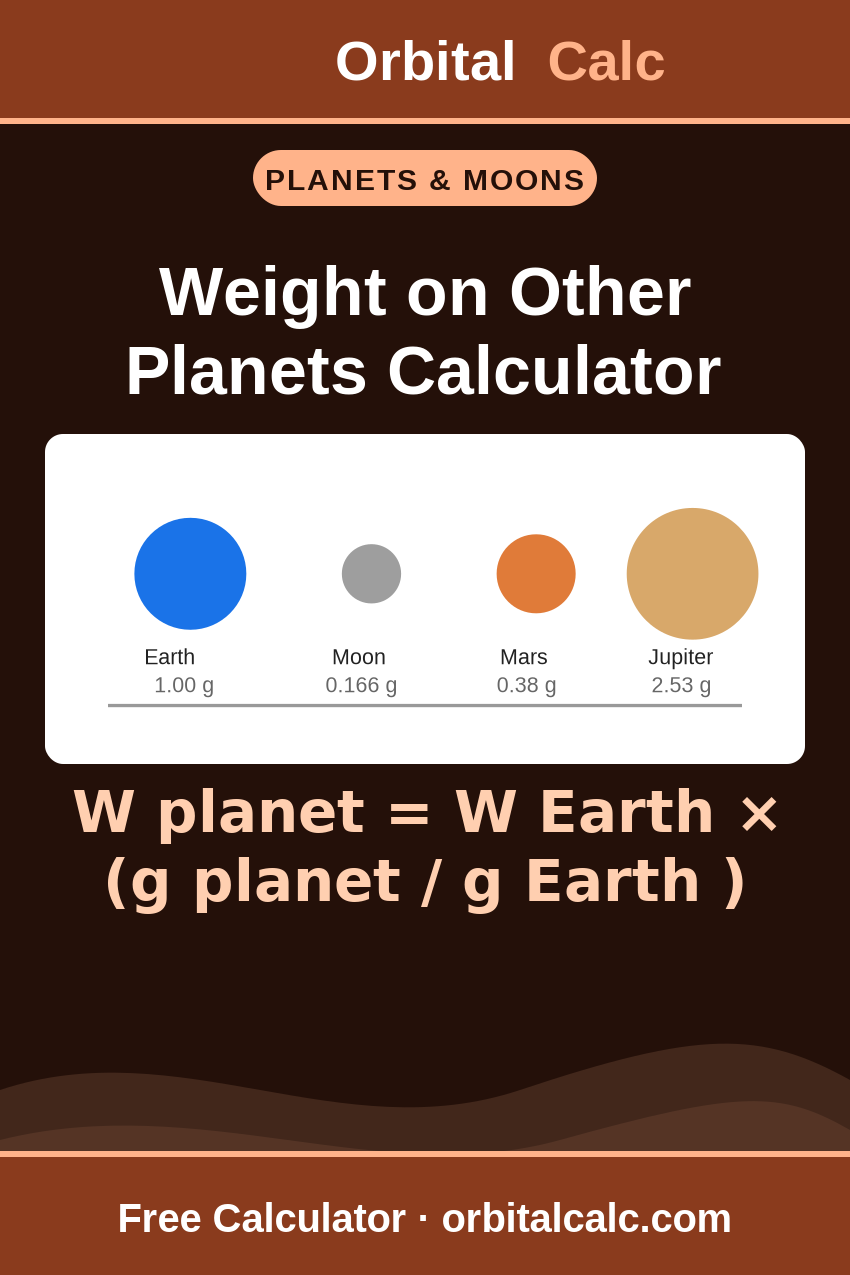
Weight on planet = Earth weight × (planet's surface gravity ÷ Earth's surface gravity) → Wplanet = WEarth × (gplanet / gEarth)
The bracket is a simple ratio. The Moon's surface gravity is 1.62 m/s² and Earth's is 9.81 m/s², so the ratio is 1.62 ÷ 9.81 ≈ 0.166 — the Moon pulls at 16.6% of Earth's strength, so everything weighs 16.6% of its Earth weight there. Mars pulls at 3.71 m/s², a ratio of 0.38. Jupiter's cloud-top gravity is about 24.79 m/s², a ratio of 2.53. Multiply any Earth weight by the ratio and you have the weight on that world.
If you want the weight as a force in newtons, multiply the mass in kilograms by the local gravity: W = m × g. A 70 kg person weighs 70 × 9.81 = 686.7 N on Earth, 70 × 9.81 × 0.166 ≈ 114.0 N on the Moon, and 70 × 9.81 × 2.53 ≈ 1,737.4 N on Jupiter. The calculator shows both the familiar "kilogram" figure (what bathroom scales would read) and the force in newtons.
| Symbol | Meaning | Units |
|---|---|---|
| Wplanet | weight on the chosen planet (scale reading) | kg |
| WEarth | weight on Earth — what you type in | kg |
| gplanet / gEarth | surface-gravity ratio of the planet to Earth | — (no unit) |
| m | mass — the same everywhere in the universe | kg |
| W = m × g | weight as a force | newtons (N) |
Surface gravity of every world
These are the ratios the calculator uses, worked out from each body's mass and radius. Two surprises hide in the table. Saturn is the second-largest planet, yet its surface gravity is barely above Earth's, because Saturn is mostly light gases — its average density is lower than water, so a Saturn-sized bathtub would float. And Mercury, the smallest planet, pulls exactly as hard as Mars, because Mercury is made of dense rock and iron while Mars is lighter for its size. Gravity at the surface depends on density as much as on size.
| World | Surface gravity (m/s²) | Ratio to Earth | 70 kg person weighs |
|---|---|---|---|
| Mercury | 3.70 | 0.38 | 26.6 kg |
| Venus | 8.87 | 0.91 | 63.7 kg |
| Earth | 9.81 | 1.00 | 70.0 kg |
| Moon | 1.62 | 0.166 | 11.6 kg |
| Mars | 3.71 | 0.38 | 26.6 kg |
| Jupiter | 24.79 | 2.53 | 177.1 kg |
| Saturn | 10.44 | 1.06 | 74.2 kg |
| Uranus | 8.69 | 0.89 | 62.3 kg |
| Neptune | 11.15 | 1.14 | 79.8 kg |
| Pluto | 0.62 | 0.06 | 4.2 kg |
| Sun | 274 | 27.94 | 1,955.8 kg |
How to use
- Type your weight on Earth in kilograms — the number your bathroom scale shows at home.
- Pick a planet from the list. The Moon is selected by default because it is the classic first question.
- Click "Calculate My Weight". You get your weight on that world, the pull in newtons, and a full table for every planet.
- If your scale reads in pounds, divide by 2.205 to get kilograms first (154 lb ÷ 2.205 ≈ 70 kg).
- Remember the number is a scale reading, not your mass — your mass in kilograms is identical on every world.
Worked examples
Example 1 — a 70 kg person on the Moon. The Moon's ratio is 0.166, so the weight is 70 × 0.166 = 11.62 kg. In force terms that is 70 × 9.81 × 0.166 ≈ 114 N, about the weight of a full suitcase on Earth. This is why Apollo astronauts could bound across the surface in stiff, heavy suits: their legs only had to lift a sixth of the load.
Example 2 — the same person on Mars. Mars's ratio is 0.38, so 70 × 0.38 = 26.6 kg. A future Mars walker carrying a 30 kg backpack of life-support gear would feel it as 30 × 0.38 = 11.4 kg — noticeable, but no worse than a school bag. Mission planners use exactly this arithmetic when they decide how much equipment a suited astronaut can carry.
Example 3 — a 60 kg astronaut on Jupiter. Jupiter's ratio is 2.53, so 60 × 2.53 = 151.8 kg. Nobody will ever stand on Jupiter — it has no solid surface — but a probe descending into its atmosphere feels that crushing pull, and any hypothetical visitor in a balloon gondola would need a chair built like a bridge.
Example 4 — a 100 kg crate on Venus and Saturn. On Venus: 100 × 0.91 = 91 kg, barely lighter than on Earth, which surprises people who expect a smaller planet to mean much less weight. On Saturn: 100 × 1.06 = 106 kg — heavier than on Earth, despite Saturn being a ball of gas, because there is so much of it that its total mass is 95 times Earth's.
Example 5 — a 45 kg child on Pluto. Pluto's ratio is 0.06, so 45 × 0.06 = 2.7 kg. The child could pick up a 200 kg piano and carry it like a shopping bag (200 × 0.06 = 12 kg), though the piano's inertia — its stubbornness about starting and stopping — would be exactly the same as on Earth. Low weight does not mean low mass, and mass is what makes things hard to push sideways.
Example 6 — a 80 kg person on the Sun. The Sun's ratio is 27.94, so 80 × 27.94 = 2,235.2 kg — over two tonnes, the weight of a large car, pressing down through your feet. In newtons that is 80 × 9.81 × 27.94 ≈ 21,926 N. The figure is purely hypothetical (the Sun's "surface" is 5,500 °C plasma), but it shows why stars hold themselves together: gravity at that strength crushes hydrogen until it fuses.
Weight, mass and the bathroom scale
Physicists are picky about two words everyday speech mixes up. Mass is how much matter you contain, measured in kilograms, and it is the same on Earth, on the Moon and in deep space. Weight is the force with which a planet pulls on that mass, measured in newtons. A bathroom scale actually measures force — how hard you squash its springs — and then divides by 9.81 to print a number in "kilograms". Take that scale to the Moon and it would print 11.6 kg for our 70 kg person, not because the person changed, but because the scale's hidden division by 9.81 is now wrong for local conditions. The calculator's kilogram figure is exactly what such a scale would say.
This distinction is not pedantry; it decides real engineering. A lunar crane lifting a 1,000 kg habitat module must support only 1,000 × 1.62 = 1,620 N of weight, so its cable can be far thinner than an Earth crane's. But swinging that module sideways still fights the full 1,000 kg of inertia, so the crane's brakes and slew motors cannot shrink at all. Every Moon and Mars machine is designed around this split between weight (which shrinks) and mass (which does not).
What would it feel like?
On the Moon (0.166 g). Your body feels feather-light, but your balance is confused: your inner ear still expects Earth-strength signals, and every step overshoots. Apollo crews settled on a loping, kangaroo-style hop because normal walking kept tipping them forward — your muscles are six times stronger than they need to be, and every push sends you sailing.
On Mars (0.38 g). Walking feels like wading through shallow water — pleasantly light, but recognisably walking. A 70 kg person weighs 26.6 kg, so a heavy spacesuit becomes manageable, and a fall from a metre lands like a fall from 38 cm on Earth. Mars is the sweet spot: low enough to make heavy work easy, high enough that your bones and muscles might stay healthy with exercise.
On Jupiter (2.53 g). Everything is a workout. Raising a 70 kg body out of a chair means lifting 177 kg. Blood pools in your legs, your heart works like it is climbing stairs forever, and lying flat would feel like having two adults sitting on your chest. Humans evolved for 1 g; 2.53 g is survivable lying down in a centrifuge for minutes, not a place to live.
In orbit (0 g). The International Space Station is not beyond gravity — at 400 km up, Earth's pull is still about 89% of its surface value. Astronauts float because the station and everything in it are falling together around the planet, so no floor pushes back. Weightlessness is free fall that never lands, which is why the calculator's Earth row, not zero, describes the gravity actually acting on the crew.
Quick reference: everyday objects on other worlds
Anchor numbers make the ratios real. Take three familiar loads — a 2 kg bag of sugar, a 10 kg suitcase and a 70 kg person — and run them through the ratios:
| Object (Earth) | On the Moon ×0.166 | On Mars ×0.38 | On Jupiter ×2.53 |
|---|---|---|---|
| 2 kg bag of sugar | 0.33 kg | 0.76 kg | 5.06 kg |
| 10 kg suitcase | 1.66 kg | 3.8 kg | 25.3 kg |
| 70 kg person | 11.62 kg | 26.6 kg | 177.1 kg |
| 1,000 kg small car | 166 kg | 380 kg | 2,530 kg |
The car row explains a classic film mistake. A lunar rover can be lifted by two astronauts because it weighs 166 kg there — but if it rolls towards you at speed, its 1,000 kg of mass still hits like a car. Weight is negotiable; momentum is not.
Common mistakes
- Saying your mass changes. It does not. Only the pull on it changes. A 70 kg astronaut is 70 kg everywhere; the scale reading changes because the scale measures force.
- Assuming bigger planet = proportionally heavier. Saturn is 9 times Earth's diameter but only 1.06 g at its cloud tops, because it is made of light gas. Surface gravity depends on mass and radius: g = GM/r².
- Using the Moon's ratio for Mars. They feel similar in films but differ by more than a factor of two: 0.166 versus 0.38. A 70 kg person is 11.6 kg on the Moon but 26.6 kg on Mars.
- Forgetting that gas giants have no surface. Jupiter and Saturn figures are for the level where the pressure equals Earth's sea-level pressure. You could not stand there; you would sink and be crushed long before.
- Mixing pounds and kilograms. The ratio works in any unit, but the input must be one consistent unit. Convert pounds to kilograms (÷ 2.205) before using the newton figure.
FAQ
How much would I weigh on the Moon?
Multiply your Earth weight by 0.166. A 70 kg person weighs 70 × 0.166 = 11.62 kg on the Moon — about the weight of a large cat. Your mass stays 70 kg; only the Moon's pull is weaker.
How much would I weigh on Mars?
Multiply by 0.38. A 70 kg person weighs 26.6 kg on Mars, a little over a third of their Earth weight. It is light enough to make heavy suits and equipment easy to carry, but strong enough to walk normally.
Which planet would make me heaviest?
Jupiter, at 2.53 times your Earth weight (ignoring the Sun, at 27.94 times). A 70 kg person would weigh 177.1 kg there — and Neptune, the runner-up, would make the same person 79.8 kg.
Does my mass change on other planets?
No. Mass is the amount of matter in you and is identical everywhere. Weight is gravity's pull on that mass, and that is what changes. Scales measure weight (force), which is why their reading changes.
Why is Saturn's gravity so low for such a big planet?
Because Saturn is mostly hydrogen and helium gas with an average density lower than water. Surface gravity grows with mass but shrinks with the square of the radius, and Saturn's huge radius spreads its mass out. The result is just 1.06 g.
Could I lift a car on the Moon?
Slowly, yes — a 1,000 kg car weighs 166 kg on the Moon, and two strong people could lift one end. But pushing it sideways or stopping it once moving still fights the full 1,000 kg of inertia, so it would be dangerous in a way the weight figure hides.
What would I weigh on the Sun?
About 28 times your Earth weight: 70 × 27.94 = 1,955.8 kg, roughly two tonnes. It is a purely theoretical number — the Sun has no solid surface and its visible layer is about 5,500 °C.
Why do astronauts float on the space station if gravity is still there?
At the station's altitude Earth's gravity is about 89% of its surface strength. The crew float because they and the station are in continuous free fall around Earth — falling together, so nothing pushes up on their feet. It is the falling, not the absence of gravity, that makes them weightless.
Is the weight on Venus really almost the same as Earth?
Yes: 0.91 g, so a 70 kg person weighs 63.7 kg. Venus is nearly Earth's twin in size and mass, which is exactly why its gravity is so similar — the crushing atmosphere and 465 °C heat are the real obstacles there, not the weight.
How is surface gravity calculated?
With Newton's law: g = G × M ÷ r², where M is the planet's mass and r its radius. Double the mass and gravity doubles; double the radius and gravity quarters. The ratios in this calculator come from applying that formula to each world and dividing by Earth's 9.81 m/s².
Sarah writes about planets, moons and the physics of everyday space questions — how gravity changes your weight, how old you would be on Mars, and how the solar system fits together. She turns orbital mechanics into numbers anyone can check.