Age on Other Planets Calculator
Use this free Age on Other Planets Calculator to find out how old you are on Mercury, Mars, Jupiter and every other planet. Enter your birth date (or your age in Earth years), pick a planet, and get your age there, your next birthday on that planet, and a full table for the whole solar system.
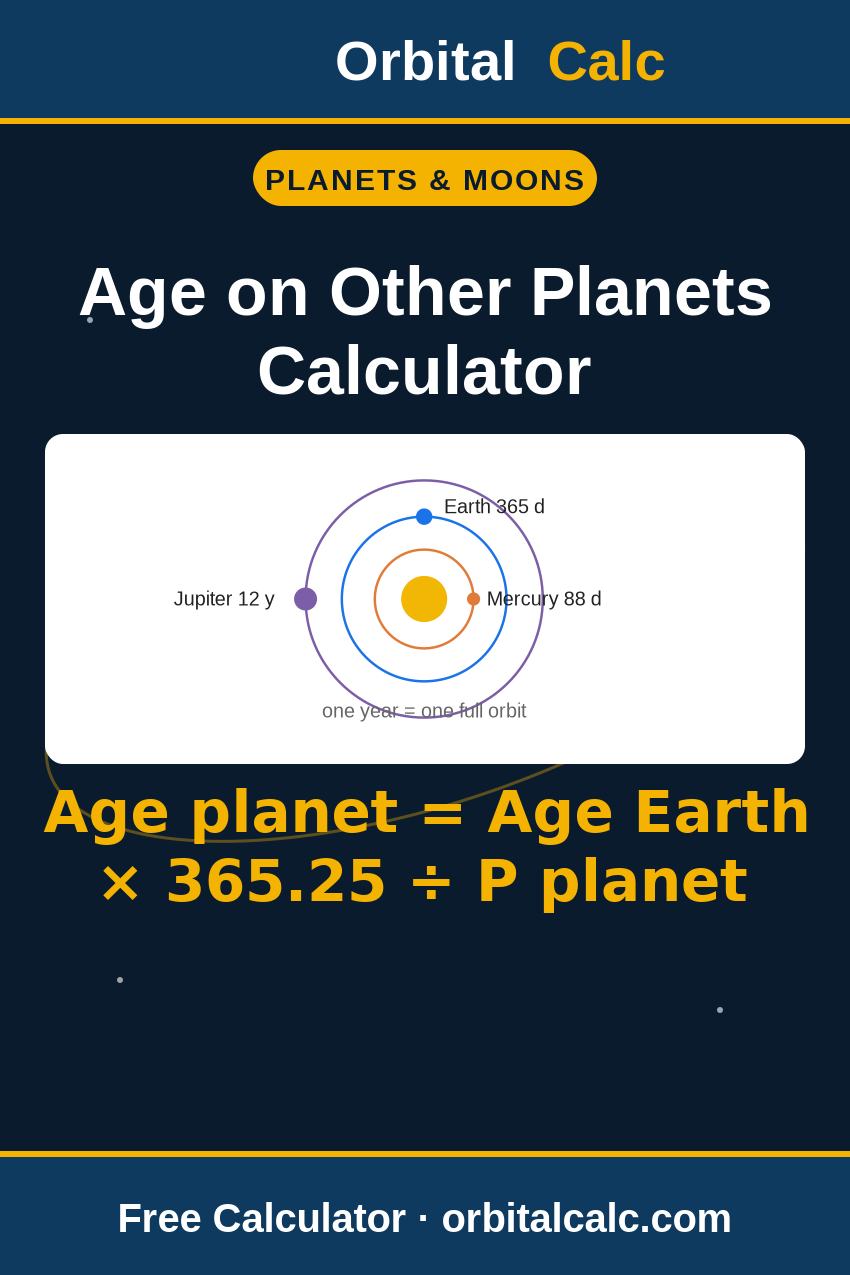
A year is not a fixed length of time — it is one trip around the Sun, and every planet makes that trip at its own pace. Mercury, sprinting around a small orbit, finishes a year in just 88 Earth days, so birthdays there come four times a year by Earth reckoning. Neptune, crawling around an orbit thirty times wider than Earth's, needs 164.8 Earth years for a single year — meaning no human being has ever been one Neptune year old, and nobody alive today ever will be. Your age in years depends entirely on which planet's calendar you count with.
The same person can be 124 years old on Mercury, 30 on Earth and barely 2½ on Jupiter, all at the same moment, without any time travel involved. Nothing about the person changes; only the ruler changes. This calculator converts your Earth age into every planet's years, and works out when your next birthday falls on the planet you choose — handy for the one birthday party where you get to be 124 and blow out the candles four times a year.
Formula
Age on planet = days lived ÷ planet's orbital period in Earth days → Ageplanet = AgeEarth × 365.25 ÷ Pplanet
First convert your age into days: an Earth age of 30 years is 30 × 365.25 = 10,957.5 days. Then divide by the length of the planet's year. Mercury's year is 88 days, so 10,957.5 ÷ 88 = 124.5 Mercury years. Mars's year is 687 days, so the same person is 10,957.5 ÷ 687 = 15.95 Mars years old. The division is the whole trick — every age on this page is one division away.
Your next birthday on a planet is the moment your planet-age ticks over to the next whole number. If you are 124.52 Mercury years old, the next birthday is 0.48 of a Mercury year away: 0.48 × 88 ≈ 42.5 Earth days from now. The calculator does this for your chosen planet and converts the wait into a calendar date.
| Symbol | Meaning | Units |
|---|---|---|
| Ageplanet | your age counted in that planet's years | planet years |
| AgeEarth | your age in Earth years — what you type in | Earth years |
| Pplanet | orbital period of the planet (one of its years) | Earth days |
| 365.25 | days in an Earth year, including leap years | days |
How long is a year on each planet?
The pattern is set by Kepler's third law: the wider the orbit, the slower the planet moves and the longer the path, so year length grows quickly with distance. Neptune is 30 times farther from the Sun than Earth, but its year is 165 times longer. The table below is the raw material of the calculator — every conversion on this page is your days lived divided by one of these numbers.
| Planet | One year (Earth days) | One year (Earth years) | A 30-year-old is… |
|---|---|---|---|
| Mercury | 88 | 0.24 | 124.5 years old |
| Venus | 225 | 0.62 | 48.7 years old |
| Earth | 365.25 | 1.00 | 30 years old |
| Mars | 687 | 1.88 | 15.95 years old |
| Jupiter | 4,332.6 | 11.86 | 2.53 years old |
| Saturn | 10,759 | 29.45 | 1.02 years old |
| Uranus | 30,687 | 84.02 | 0.36 years old |
| Neptune | 60,190 | 164.8 | 0.18 years old |
| Pluto | 90,560 | 248 | 0.12 years old |
Notice the human milestones hiding in the table. A person celebrates their first Saturn birthday at age 29.45 — roughly their 30th Earth birthday. Their first Uranus birthday comes at 84, an age a healthy person can genuinely reach: anyone born in 1942 who is still with us has had one Uranus birthday. And Pluto, demoted to dwarf planet or not, keeps the most exclusive club of all: at 248 Earth years per Pluto year, no human has ever had a first Pluto birthday, and the record for the oldest verified human life, 122 years, is not even half of one.
How to use
- Enter your birth date for the most accurate result — the calculator counts the exact days you have lived.
- Or skip the date and type your age in Earth years (decimals are fine: 30.5 works).
- Pick a planet to see when your next birthday falls there, in Earth days and as a calendar date.
- Click "Calculate My Age" for your age on the chosen planet plus the full solar-system table.
Worked examples
Example 1 — a 30-year-old on Mercury. Days lived = 30 × 365.25 = 10,957.5. Mercury years = 10,957.5 ÷ 88 = 124.5. The next Mercury birthday is (1 − 0.52) × 88 ≈ 42.5 days away — on Mercury, the wait for cake is never longer than 88 days.
Example 2 — a 30-year-old on Mars. 10,957.5 ÷ 687 = 15.95 Mars years. The same person who can rent a car on Earth is not old enough to drive on Mars — at least by the local calendar. Their 16th Mars birthday arrives after (1 − 0.95) × 687 ≈ 34.5 days.
Example 3 — a 10-year-old child. Days lived = 3,652.5. On Mercury: 3,652.5 ÷ 88 = 41.5 years old — a middle-aged Mercury citizen. On Jupiter: 3,652.5 ÷ 4,332.6 = 0.84 Jupiter years — not yet one. The child is simultaneously 41 and not-yet-1, which is why "how old are you?" is a trick question in the solar system.
Example 4 — a 20-year-old's next Mars birthday. Days lived = 7,305. Mars age = 7,305 ÷ 687 = 10.63. The fraction 0.63 of a Mars year has passed since the last birthday (0.63 × 687 ≈ 435 days), so the next one is 687 − 435 = 252 days away. Mars birthdays are rare treats: nearly two Earth years apart.
Example 5 — a 50-year-old on the giants. Days lived = 18,262.5. Jupiter age = 18,262.5 ÷ 4,332.6 = 4.22 years. Saturn age = 18,262.5 ÷ 10,759 = 1.70 years. Half a century of Earth life buys you four Jupiter birthdays and not quite two on Saturn — the outer solar system runs on a statelier clock.
Example 6 — a 90-year-old on Neptune and Uranus. Days lived = 32,872.5. Uranus age = 32,872.5 ÷ 30,687 = 1.07 years — this person has had their first Uranus birthday, at Earth age 84. Neptune age = 32,872.5 ÷ 60,190 = 0.55 years — just past the halfway mark of their first Neptune year, with 74 more Earth years needed to finish it.
Why Mercury birthdays come so fast
Mercury orbits just 58 million km from the Sun, and it does not dawdle: it races along at an average of 47 km/s, the fastest of any planet, covering its small orbit in 88 days. Earth, at 150 million km, ambles at 30 km/s and needs 365 days. Neptune, 4.5 billion km out, drifts at 5.4 km/s around an orbit 30 times wider than Earth's. Speed and distance conspire: the farther out you go, the longer the road and the slower the traffic, which is why the year lengths in the table explode as you move outward.
Venus hides a bonus oddity. Venus rotates backwards and so slowly that its day (243 Earth days, retrograde) is longer than its year (225 Earth days). A Venusian calendar-maker would face the absurdity of a year with less than one day in it — the Sun would rise in the west, crawl across the sky, and the year would end before it set. Age on Venus is easy to compute; a Venusian birthday party timed to sunrise would take some planning.
Birthday milestones worth celebrating
Because the ratios are fixed, certain Earth ages line up with round numbers elsewhere, and they make excellent excuses for cake. At 7 Earth years you turn 29 on Mercury (7 × 365.25 ÷ 88 = 29.05). At 11.86 Earth years you have your first Jupiter birthday — so most children get one in their twelfth year. At 29.45 comes the first Saturn birthday, traditionally marked by astrologers as the "Saturn return". At 59 you are 2 Saturn years old. At 84 the first Uranus birthday arrives. And at 88 Earth days old, a baby has already had a Mercury birthday — the only planet where a newborn can be a year old before it can hold its head up.
Run the numbers the other way and they get stranger. To be 100 years old on Mars you must live 188 Earth years. To be 21 on Jupiter — old enough for anything — takes 249 Earth years. The outer planets are, in birthday terms, almost uninhabitable: a colony on a moon of Saturn would need a calendar, because waiting for local birthdays would mean a party every three decades.
Quick reference: your age at a glance
For a quick sense of the spread, here are four Earth ages converted across the system (each entry is age × 365.25 ÷ period):
| Earth age | Mercury | Venus | Mars | Jupiter | Saturn |
|---|---|---|---|---|---|
| 10 | 41.5 | 16.2 | 5.3 | 0.84 | 0.34 |
| 20 | 83.0 | 32.5 | 10.6 | 1.69 | 0.68 |
| 30 | 124.5 | 48.7 | 15.9 | 2.53 | 1.02 |
| 50 | 207.5 | 81.2 | 26.6 | 4.22 | 1.70 |
Every row is the same life measured with different rulers. The Mercury column races ahead because its ruler is short; the Saturn column barely moves because its ruler is 29.45 Earth years long.
How old is the solar system in planet years?
The conversion works on any age, including the age of everything. Earth is about 4.54 billion Earth years old. In Mercury years that is 4.54 billion × 365.25 ÷ 88 ≈ 18.8 billion Mercury years — Mercury has lapped the Sun more than four times as often as Earth has existed years. In Mars years, Earth is 4.54 billion × 365.25 ÷ 687 ≈ 2.41 billion years old. In Jupiter years it is a comparatively youthful 4.54 billion ÷ 11.86 ≈ 383 million, and in Neptune years just 4.54 billion ÷ 164.8 ≈ 27.5 million — Neptune has completed only 27.5 million orbits in the entire history of the solar system, while Mercury has completed 18.8 billion.
Push the same arithmetic to the universe itself, 13.8 billion Earth years old, and the spread widens further: about 57 billion Mercury years, but only 83.7 million Neptune years. The numbers are the same trick as your own age, scaled up — one span of time, many rulers. It is a useful antidote to the feeling that a "year" is a natural unit. A year is just one planet's lap, and the universe does not care which lap you count in.
Common mistakes
- Thinking you would age slower on Jupiter. Your body ages in days, not in local years. A Jupiter "year" is just a longer label for the same flow of time; a 30-year-old is 30 years of lived days everywhere.
- Using 365 instead of 365.25. Over decades the missing quarter-days add up: at age 80 the error is 20 days, enough to shift a Mercury birthday by nearly a quarter of its year.
- Confusing a planet's day with its year. Age in years uses the orbital period (the trip around the Sun), not the rotation period. Venus's day is longer than its year, but its year is still 225 Earth days.
- Rounding the period to whole Earth years. Jupiter's year is 11.86 Earth years, not 12. Using 12 makes a 30-year-old exactly 2.5 Jupiter years instead of the correct 2.53 — small, but it compounds in next-birthday dates.
- Expecting the next birthday to be an Earth birthday. The calculator's next-birthday date is when your age on that planet reaches the next whole number, which usually falls on an unremarkable Tuesday on Earth.
FAQ
How old am I on Mars?
Divide your age in days by 687. A 30-year-old has lived 10,957.5 days, so they are 10,957.5 ÷ 687 = 15.95 Mars years old — just under 16, with the next Mars birthday about 34 days away.
How old am I on Mercury?
Divide your days lived by 88. A 30-year-old is 124.5 Mercury years old; even a 1-year-old baby is 4.15 Mercury years old. Mercury has the shortest year, so it always gives the biggest age.
What is my next birthday on another planet?
It is the date your age on that planet reaches the next whole number. If you are 10.63 Mars years old, your 11th Mars birthday is 0.37 × 687 ≈ 252 Earth days away. Pick a planet in the calculator and it gives the exact date.
Has anyone ever been 1 year old on Neptune?
No. One Neptune year is 164.8 Earth years, and the oldest verified human lifespan is 122 years. Nobody has finished a single Neptune year — the same goes for Pluto, at 248 Earth years per year.
Would I really age at a different rate on another planet?
No — this is a calendar conversion, not time travel. Your body ages by days lived, identically everywhere (relativity aside, which is negligible here). Only the number of local years those days add up to changes.
How many birthdays would I have on Mercury in one Earth year?
About four: 365.25 ÷ 88 = 4.15 Mercury years pass in each Earth year. A Mercury colonist would celebrate a birthday roughly every three Earth months.
What is a Saturn return?
It is the moment Saturn completes one full orbit since your birth — your first Saturn birthday, at Earth age 29.45. Astrologers mark it as a life milestone; astronomically it is simply 10,759 days after you were born.
Why is a year on Venus shorter than its day?
Venus orbits the Sun in 225 Earth days but rotates once, backwards, in 243 Earth days. So one Venusian day outlasts one Venusian year. Your age in Venus years still uses the 225-day orbit.
How old is the oldest person in planet years?
The oldest verified person lived 122 Earth years. That is 122 × 365.25 ÷ 88 ≈ 506 Mercury years, 122 × 365.25 ÷ 687 ≈ 64.9 Mars years, and 122 ÷ 11.86 ≈ 10.3 Jupiter years — but still only 0.74 of a Neptune year.
How accurate are the orbital periods used?
They are the standard mean orbital periods: Mercury 88, Venus 225, Mars 687, Jupiter 4,332.6, Saturn 10,759, Uranus 30,687, Neptune 60,190 and Pluto 90,560 Earth days. Real orbits vary by a day or so, which is far below the precision that matters for birthdays.
Sarah writes about planets, moons and the physics of everyday space questions — how gravity changes your weight, how old you would be on Mars, and how the solar system fits together. She turns orbital mechanics into numbers anyone can check.