Drive to the Moon Calculator
Use this free Drive to the Moon Calculator to find out how long a trip through space would take at any speed. Pick a vehicle — a car at 100 km/h, a jet, an Apollo spacecraft, Voyager 1, or light itself — choose a destination from the Moon to the nearest star, and get the travel time.
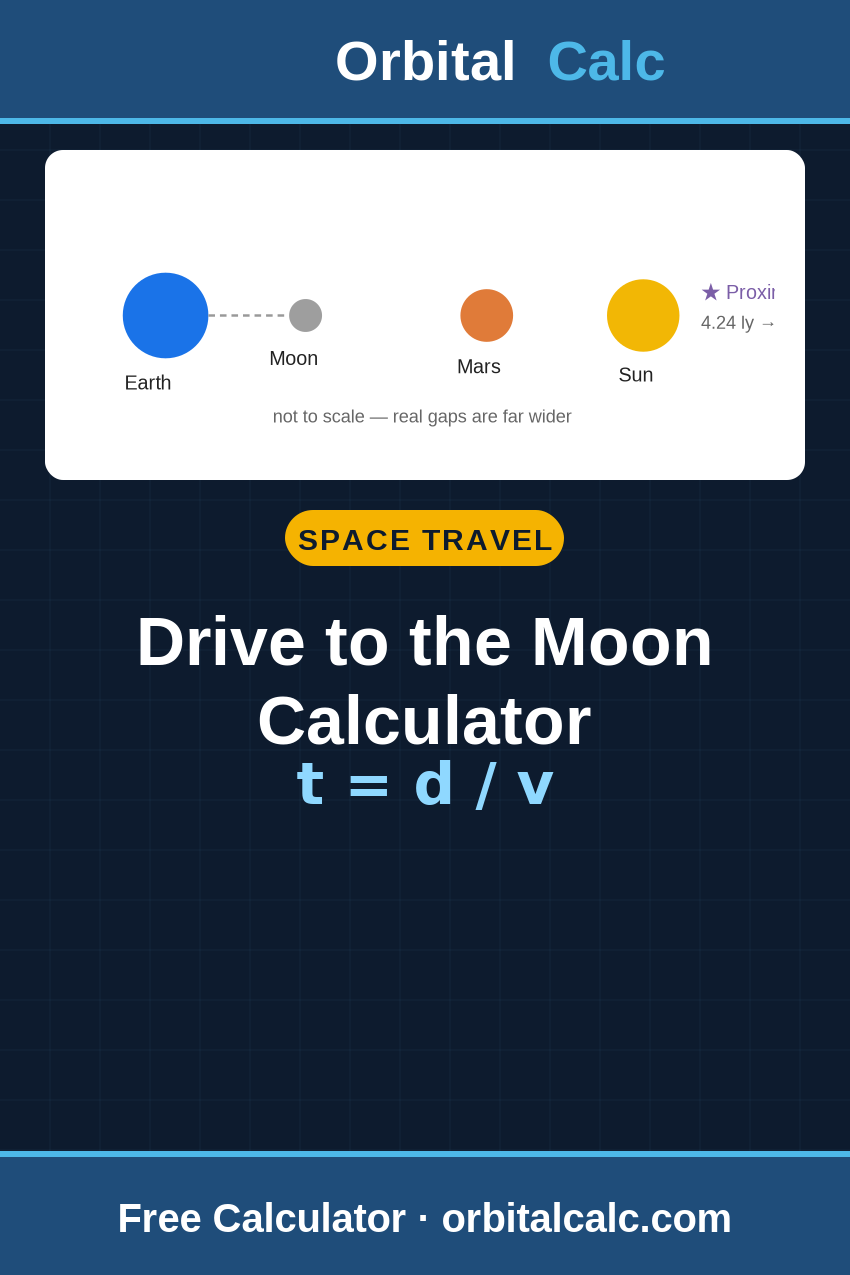
Space is big in a way that everyday numbers struggle to express. The Moon, our nearest neighbour, is 384,400 km away — about ten times around the Earth. Drive there at a steady 100 km/h, never stopping for fuel, food or sleep, and the trip takes 160 days: more than five months of continuous motorway driving. And the Moon is the close destination. The Sun is 390 times farther. Mars, at its average distance, is nearly 600 times farther than the Moon. The nearest star is so far away that its distance is measured in years of light-travel, not kilometres at all.
This calculator turns those distances into time, which is the unit human beings actually feel. It uses the one formula every journey obeys — time = distance ÷ speed — and applies it honestly: no shortcuts, no warp drive, just division. The results range from 1.28 seconds (light to the Moon) to 45 million years (a car to Proxima Centauri), and every one of them is a real consequence of how empty and enormous the universe is.
Formula
Travel time = Distance ÷ Speed → t = d / v
That is the whole calculator. The Moon is 384,400 km away; at 100 km/h the time is 384,400 ÷ 100 = 3,844 hours, which is 160.2 days. Light covers the same gap at 299,792 km/s, so 384,400 ÷ 299,792 = 1.28 seconds — the famous one-and-a-quarter-second delay that made Apollo conversations with Mission Control sound like a badly dubbed film, with a 2.56-second round trip on every exchange.
The distances used are averages, because everything in space moves. The Moon's distance swings between 356,400 km and 406,700 km over its elliptical orbit; 384,400 km is the mean. Mars is the extreme case: at closest approach it is about 56 million km away, at its farthest about 401 million km, and the average of 225 million km used here sits between. A real Mars mission times its launch for the short end of that range, which is why launch windows open only every 26 months.
| Symbol | Meaning | Units |
|---|---|---|
| t | travel time | seconds, days or years |
| d | distance to the destination | km |
| v | speed of travel | km/h (or km/s for light) |
| 1 ly | one light-year — distance light travels in a year | 9.46 × 10¹² km |
| c | speed of light in vacuum | 299,792 km/s |
The distances, honestly stated
| Destination | Distance | Light takes | Car at 100 km/h takes |
|---|---|---|---|
| Moon | 384,400 km | 1.28 s | 160 days |
| Sun | 149.6 million km | 8.32 min | 171 years |
| Mars (average) | 225 million km | 12.5 min | 257 years |
| Proxima Centauri | 4.24 light-years | 4.24 years | 45.8 million years |
Two of these numbers deserve a pause. Sunlight is eight minutes old when it reaches you: if the Sun switched off, you would not know for 8.32 minutes, and you would keep orbiting its ghost for exactly that long too, because gravity's news travels at the same speed. And the car-to-Proxima figure — 45.8 million years — is longer than the entire history of the human species many times over. Interstellar distances are not "far" in the way another continent is far; they are a different category of far.
The Moon's distance deserves its own footnote, because it visibly changes. The Moon's orbit is an ellipse, so its distance swings from 356,400 km at perigee to 406,700 km at apogee — a difference of 50,300 km, more than the Earth's circumference. In travel terms, our 100 km/h car would need 148.5 days at perigee but 169.5 days at apogee, and light's one-way trip stretches from 1.19 to 1.36 seconds. That same swing is why some full moons look bigger than others: a "supermoon" is simply the Moon near perigee, up to 14% wider in the sky than at apogee. The calculator uses the 384,400 km average, so its answers sit between those extremes.
How to use
- Pick a vehicle from the list, or choose "Custom speed" and type any speed in km/h (a Formula 1 car at 350 km/h, a bullet at 3,600 km/h — anything).
- Pick a destination: Moon, Sun, Mars (average distance) or Proxima Centauri, the nearest star.
- Click "Calculate Travel Time" for the journey time to your destination, plus a table of all four destinations at your speed.
- Times assume constant speed in a straight line with no stops — the most generous possible reading. Real missions curve, coast and brake, so treat the numbers as best cases.
Worked examples
Example 1 — driving to the Moon. t = 384,400 ÷ 100 = 3,844 hours = 160.2 days of non-stop driving. With 8 hours of driving a day and the rest for sleep, the same trip stretches past 16 months. The Apollo astronauts covered it in about 3 days — not by driving faster in a straight line, but by coasting along a curved path after one big push from their rocket.
Example 2 — a jet to the Moon. t = 384,400 ÷ 900 = 427.1 hours = 17.8 days. A passenger jet at cruising speed, flying the equivalent of about 96 London–New York crossings back to back, would reach the Moon in under three weeks — if only there were air to fly through and fuel stations along the way.
Example 3 — Apollo speed to Mars. t = 225,000,000 ÷ 39,000 = 5,769 hours = 240 days, about 8 months. Real Mars probes take roughly 7 months, because they launch when Mars is nearer than average and follow energy-saving curved paths. The calculator's straight-line estimate lands reassuringly close to mission reality.
Example 4 — light to Mars, and why rovers drive themselves. t = 225,000,000 ÷ 299,792 = 750.5 seconds = 12.5 minutes one way at average distance (3 minutes at closest approach, 22 at farthest). A joystick on Earth would lag half an hour behind the rover's wheels, so Mars rovers are given goals, not steering commands, and they navigate the details alone.
Example 5 — Voyager 1 to the nearest star. Voyager 1 travels at about 17 km/s (61,200 km/h), the fastest human-made object. Proxima Centauri is 4.011 × 10¹³ km away, so t = 4.011 × 10¹³ ÷ 61,200 ≈ 6.55 × 10⁸ hours ≈ 74,800 years. Voyager is not even heading there — it will pass within 1.6 light-years of another star, Gliese 445, in about 40,000 years.
Example 6 — walking to the Moon. t = 384,400 ÷ 5 = 76,880 hours = 8.8 years of walking 24 hours a day. At a realistic 8 hours a day it is over 26 years — a whole career of walking, covering the equivalent of 9.6 laps of the Earth's equator, to reach a destination that light reaches before you finish blinking.
Why Apollo took 3 days, not 10 hours
Divide the Moon's distance by Apollo's top speed and you get 384,400 ÷ 39,000 ≈ 9.9 hours — yet Apollo 11 took about 75 hours to get there. The discrepancy is the difference between a road trip and an orbit. A spacecraft cannot simply aim at the Moon and floor it: it must arrive slowly enough to be captured by lunar gravity, along a path curved by two planets' pulls, and it spends most of the journey coasting uphill against Earth's gravity, bleeding speed the whole way. Apollo's 39,000 km/h was a brief peak just after the engine burn; for most of the coast the spacecraft travelled far slower. The calculator's straight-line, constant-speed answer is therefore a floor, not a schedule — real spaceflight always takes longer than the division suggests, and the gap between the two numbers is exactly where orbital mechanics lives.
Quick reference: every vehicle to every destination
| Vehicle | Moon | Sun | Mars (avg) | Proxima |
|---|---|---|---|---|
| Walking 5 km/h | 8.8 years | 3,413 years | 5,134 years | 915 million years |
| Car 100 km/h | 160 days | 171 years | 257 years | 45.8 million years |
| Jet 900 km/h | 17.8 days | 19.0 years | 28.5 years | 5.1 million years |
| Apollo 39,000 km/h | 9.9 hours | 160 days | 240 days | 117,000 years |
| Voyager 1 61,200 km/h | 6.3 hours | 102 days | 153 days | 74,800 years |
| Light 299,792 km/s | 1.28 s | 8.32 min | 12.5 min | 4.24 years |
Read down the Proxima column and the lesson of interstellar flight appears: even the fastest object humanity has ever built needs 75 millennia. To cross to the nearest star in a human lifetime needs speeds of a few percent of light speed — a hundred times faster than Voyager — which is why interstellar probes remain paper studies and the Voyagers, launched in 1977, are still the record holders.
What about the edge of the solar system?
The calculator's four destinations are only the beginning of the journey. Neptune, the farthest planet, orbits 4,495 million km from the Sun: light needs 4,495,000,000 ÷ 299,792 ≈ 14,994 seconds ≈ 4.16 hours to get there, and our 100 km/h car would need 4,495,000,000 ÷ 100 = 44,950,000 hours ≈ 5,128 years — longer than recorded history. The New Horizons probe, launched in 2006 at record speed, still took nine and a half years to reach Pluto, which is closer than Neptune's far side.
Beyond the planets, the distances stop being polite. Voyager 1, the farthest human-made object, is now about 24 billion km from the Sun. A radio signal from it — travelling at light speed — takes 24,000,000,000 ÷ 299,792 ≈ 80,055 seconds ≈ 22.2 hours to reach Earth, which is why conversations with Voyager are conducted a day at a time. Our car would need 24,000,000,000 ÷ 100 = 240,000,000 hours ≈ 27,400 years to catch up with it. And Voyager has not even left the Sun's gravitational household: the Oort cloud of comets may extend to 100,000 times the Earth–Sun distance, where light itself needs 100,000 × 499 seconds ≈ 1.58 years for the one-way trip. Proxima Centauri, at 4.24 light-years, is less than three times farther than the edge of our own comet cloud — the stars begin almost where the solar system ends, and both are unreachable by anything we can currently build.
Common mistakes
- Using the closest Mars distance as "the" distance. Mars ranges from 56 million to 401 million km. Quoting only the minimum makes every trip look four times shorter than the average used here.
- Forgetting that light speed is a limit, not a vehicle. The light-speed row shows the fastest any signal — or anything — can make the trip. A ship at even 10% of light speed would take ten times longer than that row.
- Mixing km/h and km/s. Light travels 299,792 km every second. Enter it as km/h and every answer shrinks 3,600-fold. The presets handle the units for you.
- Assuming the straight line is the flight path. Spacecraft follow curved, gravity-shaped trajectories and must slow down on arrival. Real trips take longer than t = d/v — Apollo's 75 hours versus the naive 9.9 is the standing example.
- Treating a light-year as a time. Despite the name it is a distance: 9.46 trillion km. Proxima's 4.24 light-years means light needs 4.24 years to cross it — the calculator uses both forms consistently.
FAQ
How long would it take to drive to the Moon?
At a steady 100 km/h with no stops: 384,400 ÷ 100 = 3,844 hours, or 160.2 days — over five months. Driving 8 hours a day, it would take about 16 months.
How long does light take to reach the Moon?
About 1.28 seconds (384,400 ÷ 299,792). The round trip is 2.56 seconds, which is the pause you hear in Apollo mission recordings between Houston's question and the astronauts' reply.
How long would it take to fly to Mars?
At Apollo speed (39,000 km/h) and average distance: 225,000,000 ÷ 39,000 ≈ 240 days. Real missions take about 7 months by launching when Mars is closer than average.
How far is the nearest star?
Proxima Centauri is 4.24 light-years away — about 40 trillion km. Light needs 4.24 years; Voyager 1, our fastest probe, would need roughly 74,800 years.
Why does sunlight take 8 minutes to reach us?
The Sun is 149.6 million km away and light travels 299,792 km/s, so 149,600,000 ÷ 299,792 ≈ 499 seconds = 8.32 minutes. You always see the Sun as it was eight minutes ago.
Could a car really drive to the Sun in 171 years?
Arithmetically, yes: 149.6 million km at 100 km/h is 1,496,000 hours ≈ 171 years. Practically, the car would need a road, fuel for 171 years, and a driver whose great-great-grandchildren finished the trip — and it would melt long before arrival.
What is the fastest human-made object?
Voyager 1, at about 17 km/s (61,200 km/h) relative to the Sun. The Parker Solar Probe moves faster relative to the Sun at its closest approach — over 190 km/s — thanks to falling towards the Sun, but Voyager holds the record for leaving the solar system.
Why can't we just fly faster to the stars?
Speed costs energy, and the cost grows brutally: doubling a spacecraft's speed needs roughly four times the energy. Reaching even 10% of light speed for a small probe would need energies far beyond any rocket yet built, which is why interstellar travel is still theoretical.
How long would a radio message to Mars take?
The same as light: 12.5 minutes one way at average distance, between 3 and 22 minutes depending on where the planets are. That delay is why Mars rovers navigate autonomously instead of being driven live from Earth.
Does the calculator account for the planets moving?
It uses average distances, so it is a best-case estimate. In reality you must aim at where the destination will be when you arrive — for Mars, months ahead of its current position — which is why real missions launch in narrow windows every 26 months.
Priya writes about the distances and times that make space feel vast: light-travel delays, Voyager's journey, and how long real spacecraft take to cross the solar system. She specialises in making huge numbers understandable.