Light Travel Time Calculator
Use this free Light Travel Time Calculator to find how long light — or a radio signal, which travels at the same speed — takes to cross any distance in space. Pick a target such as the Moon, the Sun or the nearest star, or enter your own distance, and get both the one-way light time and the round-trip signal delay.
Light is the fastest thing in the universe, yet space is so large that even light needs time to get around. Sunlight takes about eight and a third minutes to reach your eyes, which means you always see the Sun as it was eight minutes ago. A radio message to a Mars rover can take over twenty minutes to arrive, and the reply takes just as long to come back — which is why rovers cannot be driven with a joystick, and why mission controllers send instructions and then wait, sometimes for the better part of an hour, to learn whether they worked.
Because the speed of light is a fixed constant — 299,792.458 kilometres per second — light travel time is simply distance divided by that constant. This one division quietly governs everything from the delay in a satellite phone call to the fact that the most distant galaxies are seen as they were billions of years ago. When you look at the Andromeda Galaxy on a dark night, the light entering your eye left it 2.5 million years ago, before human beings existed.
Formula
One-way light time = Distance ÷ Speed of light → t = d / c • Round-trip delay = 2 × d / c
The speed of light in vacuum, c, is exactly 299,792.458 km/s — it is a defined constant, not a measured approximation, because the metre itself is defined through it. One astronomical unit (the average Earth–Sun distance, 149,597,870.7 km) therefore corresponds to a light time of 149,597,870.7 ÷ 299,792.458 = 499.005 seconds. That single number, about 8 minutes 19 seconds, is the building block of almost every calculation on this page: multiply it by a distance in AU and you have the one-way light time in seconds.
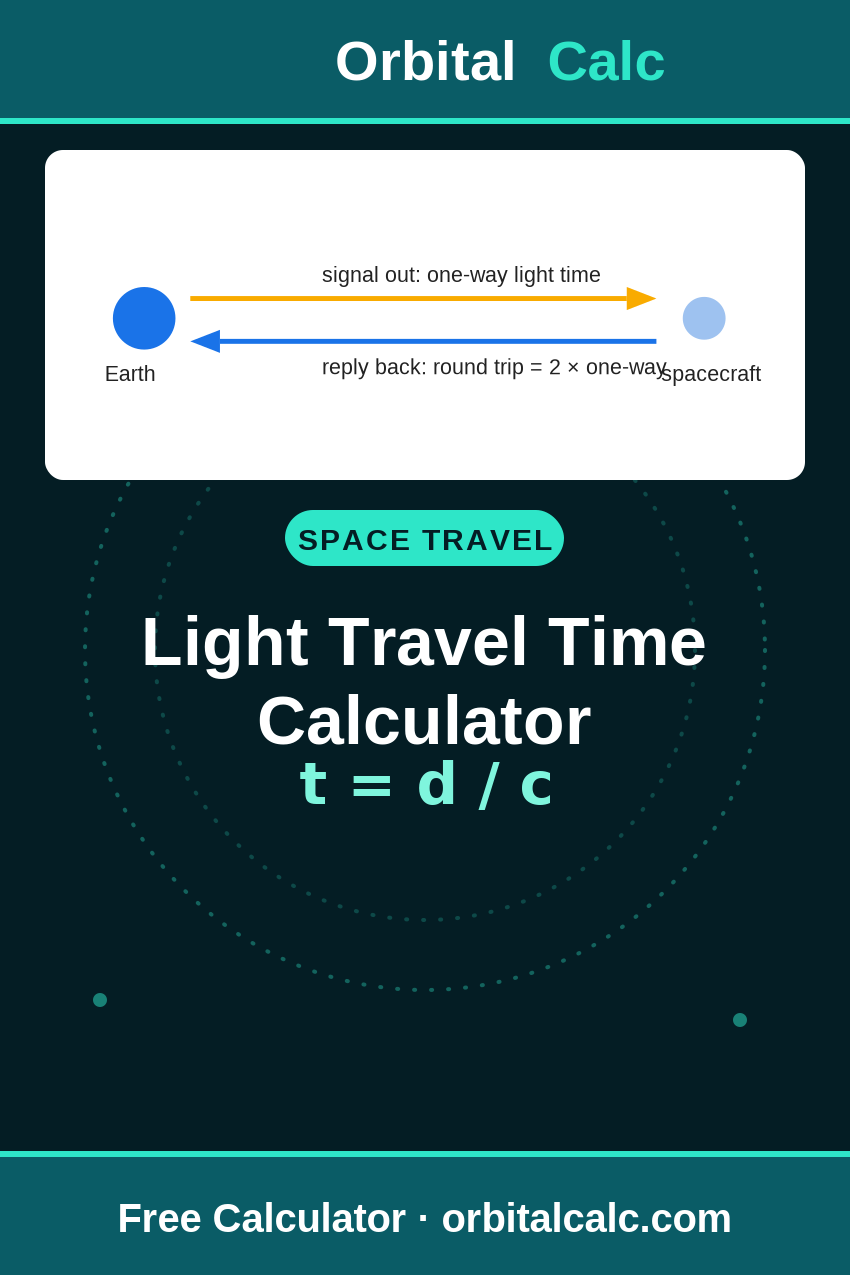
Radio waves, microwaves, X-rays and visible light all travel at c in vacuum, so "light time" and "signal delay" are the same number. The round-trip delay — send a command, wait for the reply — is exactly twice the one-way time, and it is the number mission controllers actually feel: it is the minimum time between asking a spacecraft a question and hearing the answer, even with perfect equipment.
| Symbol | Meaning | Units |
|---|---|---|
| t | one-way light travel time | seconds (s), converted as needed |
| d | distance the light crosses | km, AU or light-years |
| c | speed of light in vacuum | 299,792.458 km/s (exact) |
| AU | astronomical unit = 149,597,870.7 km | light time 499.005 s |
| ly | light-year = 9.4607 × 10¹² km | light time exactly 1 year |
Seeing the past
Every light-time calculation is also a statement about the past. When a telescope receives light from Proxima Centauri, that light is 4.24 years old; the star has had 4.24 years to change since the light left it, and we cannot know its present state until more light arrives. For the Andromeda Galaxy the look-back time is 2.5 million years. For the most distant galaxies ever observed it exceeds 13 billion years — we see them as they were when the universe was young, which is precisely why astronomers prize them: light's finite speed turns every telescope into a time machine, and the one-way column of this calculator is its dial.
How to use
- Choose a target, or select "Custom distance" and enter your own value in km, AU or light-years.
- Click "Calculate Light Time" to get the one-way time and the round-trip signal delay.
- Planet distances are averages. Mars, for instance, ranges from about 3.0 light-minutes away at closest approach to about 22.3 light-minutes on the far side of the Sun.
- For a spacecraft at a known distance in AU, enter that number with the AU unit — each AU adds 499.005 seconds of one-way delay.
Worked examples
Example 1 — Earth to the Moon. The Moon is 384,400 km away. One-way light time = 384,400 ÷ 299,792.458 = 1.28 seconds; a radio round trip takes 2.56 seconds. Apollo astronauts' conversations with Houston had exactly this noticeable pause — long enough to talk over each other, short enough to hold a real conversation.
Example 2 — sunlight reaching Earth. The Sun is 1 AU away: 149,597,870.7 ÷ 299,792.458 = 499.005 seconds = 8.32 minutes one way. If the Sun somehow switched off, we would not know for 8.32 minutes — and Earth's orbit would not respond to the missing gravity until the same moment, because gravity too propagates at light speed.
Example 3 — talking to Mars. At the average distance of 225,000,000 km, one-way light time = 225,000,000 ÷ 299,792.458 = 750.52 seconds = 12.51 minutes, so a command-and-reply round trip takes about 25.02 minutes. At closest approach (54.6 million km) the one-way time shrinks to about 3.04 minutes; at the far side of the Sun (401 million km) it stretches to about 22.29 minutes.
Example 4 — Jupiter. At an average 778,000,000 km, light needs 778,000,000 ÷ 299,792.458 = 2,595.13 seconds = 43.25 minutes one way. When NASA's Juno spacecraft performs a manoeuvre at Jupiter, controllers wait over an hour and a half for the round-trip confirmation — 86.5 minutes of silence built into every command.
Example 5 — Pluto. Pluto averages 39.48 AU from the Sun. One-way light time = 39.48 × 499.005 = 19,700.71 seconds = 5.47 hours. During the New Horizons flyby in 2015, every signal from the spacecraft was already more than four hours old when it arrived — the encounter was flown entirely by pre-programmed instructions.
Example 6 — Proxima Centauri. The nearest star is 4.24 light-years away, so by definition its light takes 4.24 years to reach us, and a hypothetical radio round trip would take 8.48 years. There is no conversation with Proxima; there is only correspondence across decades.
Signal delays in real missions
Mars rovers. Perseverance and Curiosity are driven in daily batches: engineers build a sequence of commands, send it, and wait for the results the next sol. With one-way delays of 3–22 minutes, real-time driving is impossible — by the time a hazard appeared on screen, the rover would already have driven into it. The rovers therefore carry autonomy software that can stop, choose safe paths and even select rock targets on its own.
Voyager 1. At about 162 AU from the Sun, Voyager 1's one-way light time is 162 × 499.005 ≈ 80,839 seconds ≈ 22.46 hours. A command sent today is answered, at the very earliest, the day after tomorrow. Our Voyager 1 Distance Calculator tracks this growing delay.
Satellite telephones and GPS. Even near Earth, light time is not zero. A geostationary satellite sits about 35,786 km up, so a signal's round trip to it and back covers roughly 71,572 km and takes about 0.24 seconds — the slight pause you may notice on satellite calls. GPS receivers exploit the same arithmetic in reverse: measuring how long each satellite's signal took to arrive, they multiply by c to get their distance from each satellite and triangulate their position.
Solar conjunction moratorium. Once per synodic cycle, each outer planet passes behind the Sun as seen from Earth, and for a week or two the radio path to it grazes the Sun's corona. The hot, turbulent plasma there scrambles radio signals — a phenomenon called solar scintillation — so missions impose a moratorium: no critical commands are sent, and spacecraft are left in a safe, autonomous state until the geometry improves. The light time itself barely changes during conjunction (Mars is near its maximum of about 22.3 minutes), but the quality of the link collapses. It is a useful reminder that a signal delay is not the only price of distance; the signal must also survive the journey.
Quick reference: light times across the solar system
The table below collects the one-way light times that mission planners carry in their heads. Notice the pattern: inside the solar system the natural unit is the light-minute (about 18 million km), and every AU of distance adds almost exactly 8⅓ of them.
| Destination | One-way light time | Round trip |
|---|---|---|
| Moon (384,400 km) | 1.28 s | 2.56 s |
| Sun (1 AU) | 8.32 min | 16.63 min |
| Mars, closest (54.6M km) | 3.04 min | 6.07 min |
| Mars, average (225M km) | 12.51 min | 25.02 min |
| Mars, farthest (401M km) | 22.29 min | 44.59 min |
| Jupiter, average (778M km) | 43.25 min | 86.5 min |
| Pluto, average (39.48 AU) | 5.47 hours | 10.94 hours |
| Voyager 1 (≈162 AU) | ≈ 22.46 hours | ≈ 44.9 hours |
| Proxima Centauri (4.24 ly) | 4.24 years | 8.48 years |
Why nothing can beat the delay
It is tempting to ask whether some future technology — quantum entanglement, say — could send messages instantly and abolish light-time delays. It cannot: entangled particles produce correlated results, but no usable information travels between them faster than light; each side sees only random outcomes until the two records are compared through an ordinary, light-speed channel. Relativity's speed limit is not an engineering obstacle like a slow engine; it is woven into the structure of cause and effect. The round-trip column of this calculator is therefore a permanent feature of spaceflight: the farther we go, the more our spacecraft must think for themselves.
The Deep Space Network: listening across light-hours
Every number on this page is a daily working reality for NASA's Deep Space Network (DSN) — three complexes of giant dish antennas in California, Spain and Australia, spaced around the globe so that at least one always faces any given spacecraft. The DSN's dishes are up to 70 metres across, yet the signals they catch from the outer solar system are almost unimaginably faint: by the time Voyager 1's radio transmission has spread across 160-plus AU of space, the power arriving at Earth is around 10⁻¹⁶ watts — twenty billion times weaker than the power needed to run a digital watch. The light-time delay is only half the challenge; the other half is that a signal delayed by 22 hours is also a signal diluted by the square of that enormous distance.
The delay shapes operations in ways that surprise newcomers. Commands are transmitted "blind": controllers send an instruction, then wait a full round trip — at Jupiter, about 86 minutes; at Voyager, nearly two days — before telemetry confirms it arrived. Spacecraft therefore carry fault-protection software that can safe itself without waiting for Earth, because a problem that needs a response in five minutes cannot wait for a conversation that takes two days. The one-way column of this calculator is, quite literally, the minimum reaction time of the human race beyond Earth orbit.
Light time and the edge of the observable universe
Stretch the same division to its limit and it defines what can be seen at all. The universe is about 13.8 billion years old, so no light has had more than 13.8 billion years to travel — yet the observable universe is about 93 billion light-years across, because space itself expanded while the light was in flight, carrying the sources farther away. Light-time arithmetic alone (distance ÷ c) gives the look-back time — how long the light travelled — which for the most distant galaxies is about 13 billion years. The cosmic microwave background, the oldest light of all, has been travelling for 13.8 billion years and reaches us stretched into microwaves by the expansion of space. Every entry in this calculator, from the Moon's 1.28 seconds to Andromeda's 2.5 million years, is one rung on that same ladder: to look out into space is to look back in time, and the exchange rate is exactly one year of time per light-year of distance.
Common mistakes
- Confusing light-years with years of travel. A distance of 4.24 light-years means light takes 4.24 years — a spacecraft at 17 km/s takes about 74,772 years over the same distance.
- Forgetting the round trip. Communication delay is twice the one-way light time. A "12-minute delay to Mars" means 24 minutes before you can hear a reply.
- Using a single fixed distance for a planet. Earth–Mars distance varies by more than a factor of seven over the synodic cycle, so the light time varies from about 3 to about 22 minutes. Always ask "distance on which date?"
- Assuming radio is slower than light. Radio waves are light — the same electromagnetic radiation at a longer wavelength — and travel at exactly c in vacuum.
- Treating 8 minutes 20 seconds as exact for the Sun. Earth's orbit is slightly elliptical, so the true figure varies between about 8 minutes 11 seconds (perihelion) and 8 minutes 27 seconds (aphelion) through the year.
FAQ
How long does light take to reach Earth from the Sun?
About 499 seconds — 8.32 minutes. The exact value varies slightly through the year because Earth's orbit is elliptical: roughly 8 min 11 s at perihelion (January) to 8 min 27 s at aphelion (July).
What is the signal delay to Mars?
One way, between about 3.04 minutes (closest approach) and 22.29 minutes (farthest), averaging about 12.51 minutes. Double those figures for a command-and-reply round trip.
How far is one light-second?
299,792.458 km — about 78% of the way to the Moon. The Moon is 1.28 light-seconds away; the Sun is 499 light-seconds (8.32 light-minutes) away.
How long does a signal take to reach Voyager 1?
At roughly 162 AU, about 22.46 hours one way, growing by about half an hour every year as the probe recedes at 3.57 AU per year. A round trip is already close to two days.
Can we communicate with a spacecraft instantly using quantum entanglement?
No. Entanglement cannot transmit usable information faster than light; the correlations only become visible when results are compared via a normal light-speed channel.
Why do we see distant galaxies as they were long ago?
Because their light has been travelling for that long. Andromeda's light left 2.5 million years ago; the most distant galaxies' light left over 13 billion years ago, when the universe was young.
What is the light time to the galactic centre?
The centre of the Milky Way is about 26,000 light-years away, so its light — and any hypothetical signal — takes 26,000 years one way, 52,000 years round trip.
Does light travel at the same speed through glass or water?
No — it slows in transparent materials (to about 200,000 km/s in glass), which is why lenses bend light. This calculator uses the vacuum speed, correct for space and for signals between spacecraft.
How long is a light-year in kilometres?
9.4607 × 10¹² km — about 9.46 trillion km, or 63,241 AU. It is a unit of distance, despite the word "year" in its name.
If the Sun disappeared, when would Earth notice?
After 8.32 minutes — both the light and the gravitational influence travel at c, so Earth would keep orbiting the empty point, in daylight, for those eight minutes.
Priya writes about the distances and times that make space feel vast: light-travel delays, Voyager's journey, and how long real spacecraft take to cross the solar system. She specialises in making huge numbers understandable.