Star Distance Converter
Use this free Star Distance Converter to translate between the units astronomers use for the distances to stars: kilometres, astronomical units (AU), light-years and parsecs. A second tool below converts a star's measured parallax — the tiny apparent wobble in its position — directly into its distance in parsecs.
Stellar distances defeat everyday units. The nearest star, Proxima Centauri, is about 40 trillion kilometres away; writing that as 40,113,000,000,000 km helps nobody. Astronomers therefore climb a ladder of ever-larger units. The AU (the Earth–Sun distance) suits the solar system. The light-year — how far light travels in a year — suits the neighbourhood of stars. And the parsec, born directly from the geometry of measuring star distances, is the unit professionals actually work in. Knowing how to move between them is the first skill of practical astronomy.
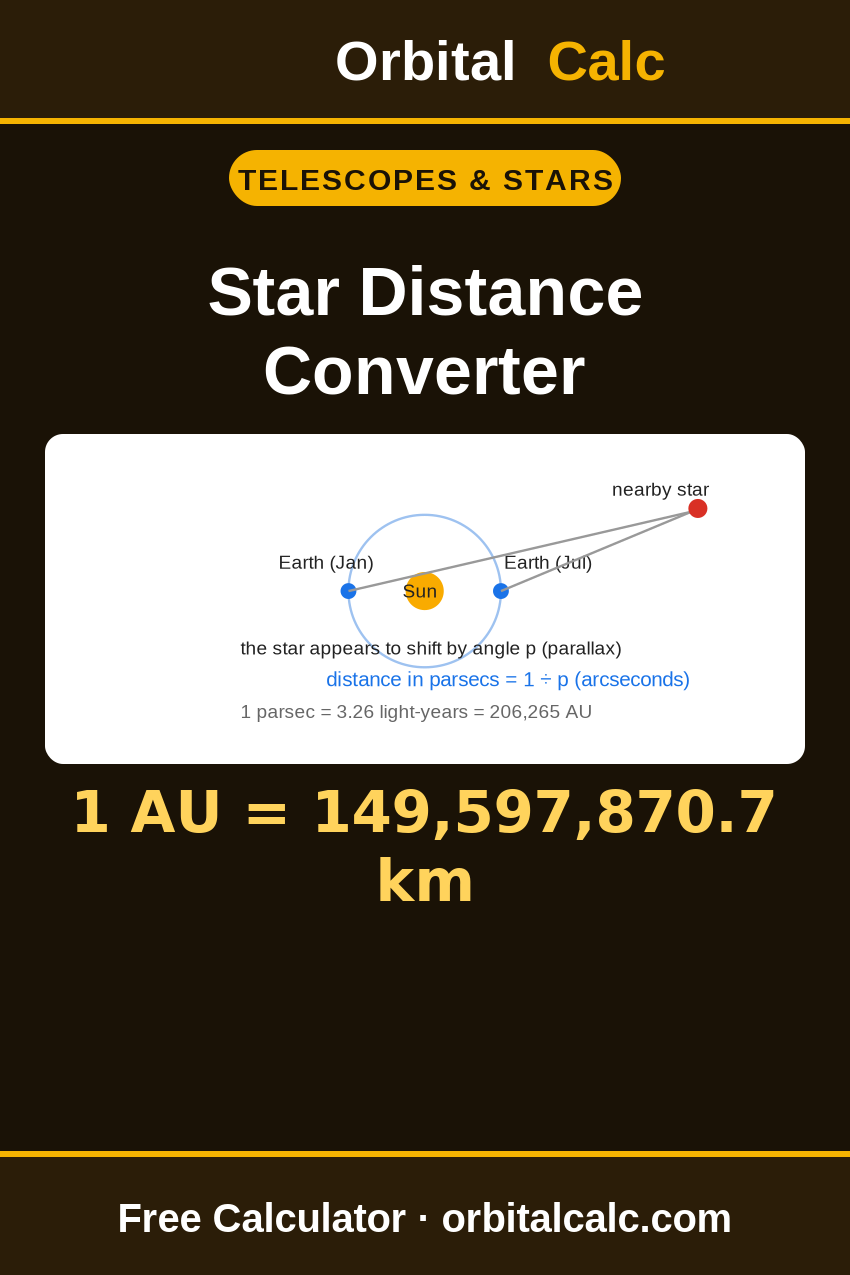
The parsec deserves its place. As Earth orbits the Sun, a nearby star appears to shift slightly against the distant background — an effect called parallax, the same shift your thumb makes against a wall when you blink between eyes. A star whose parallax is exactly one arcsecond (1/3600 of a degree) is, by definition, one parsec away. Measure the wobble, invert it, and you have the distance: d = 1/p. It is the only direct, geometry-only way to measure a star's distance, and every other rung of the cosmic distance ladder is calibrated against it.
Convert a distance
Distance from parallax (d = 1/p)
Formulas
1 AU = 149,597,870.7 km • 1 light-year = 9.4607 × 10¹² km = 63,241 AU • 1 parsec = 3.26156 light-years = 206,265 AU = 3.0857 × 10¹³ km • Distance from parallax: d (parsecs) = 1 ÷ p (arcseconds)
Each unit is anchored to something measurable. The AU is the average Earth–Sun distance, now defined exactly as 149,597,870,700 metres. The light-year is the speed of light (299,792.458 km/s) multiplied by the seconds in a Julian year (31,557,600), giving 9.4607 × 10¹² km. The parsec is pure geometry: it is the distance at which 1 AU — the radius of Earth's orbit — subtends an angle of one arcsecond. Since a full circle contains 360 × 3,600 = 1,296,000 arcseconds, and a radian is 206,265 arcseconds, one parsec works out to exactly 206,265 AU (to the precision anyone needs).
Converting between units is therefore a chain of multiplications. The calculator first turns your input into kilometres, then divides by each unit's length in kilometres to produce all four values. For parallax, the formula is a single inversion — but note the direction of the relationship: larger parallax means a nearer star. Proxima Centauri's parallax of 0.7687 arcseconds is the largest of any star beyond the Sun, which is exactly how we know it is the closest.
| Unit | In kilometres | In AU | In light-years |
|---|---|---|---|
| 1 AU | 1.496 × 10⁸ | 1 | 1.581 × 10⁻⁵ |
| 1 light-year | 9.461 × 10¹² | 63,241 | 1 |
| 1 parsec | 3.086 × 10¹³ | 206,265 | 3.26156 |
| 1 kiloparsec | 3.086 × 10¹⁶ | 2.063 × 10⁸ | 3,261.56 |
How parallax measurement works
Astronomers photograph a star in January and again in July, when Earth is on opposite sides of its orbit — a baseline of 2 AU, about 300 million km. A nearby star appears to shift against the far background stars by a tiny angle, twice its parallax. Even for Proxima Centauri that shift is under 1.6 arcseconds — roughly the angle of a coin seen from 3 km away — which is why stellar parallax was not measured until 1838 (by Friedrich Bessel, for the star 61 Cygni), despite being predicted by Copernicus three centuries earlier.
Modern measurements come from space. The European Space Agency's Gaia satellite measures parallaxes to about 0.00002 arcseconds for bright stars, reaching useful distances of thousands of parsecs — a substantial slice of the Milky Way. Beyond that, the wobble drowns in measurement noise, and astronomers switch to indirect methods (standard candles, redshift) that are all ultimately calibrated against the parallax scale. That is why the humble formula d = 1/p underpins the entire distance scale of the universe.
How to use
- For a unit conversion, enter the distance, choose its unit, and click "Convert Distance" — all four units are shown.
- For a parallax distance, enter the parallax in arcseconds (for example 0.7687 for Proxima Centauri) and click "Calculate Distance".
- Very large or small results are shown with commas and, where helpful, in billions or trillions of kilometres.
- Remember: a larger parallax means a closer star. A parallax of 1 arcsecond = 1 parsec; 0.1 arcseconds = 10 parsecs; 0.01 = 100 parsecs.
Worked examples
Example 1 — Proxima Centauri in every unit. Enter 4.24 light-years. In parsecs: 4.24 ÷ 3.26156 = 1.30 pc. In AU: 4.24 × 63,241 = 268,142 AU. In kilometres: 4.24 × 9.4607 × 10¹² ≈ 40.11 trillion km — which is why nobody quotes stellar distances in kilometres.
Example 2 — Proxima Centauri from its parallax. Proxima's measured parallax is 0.7687 arcseconds. Distance = 1 ÷ 0.7687 = 1.30 parsecs = 1.30 × 3.26156 = 4.24 light-years. The two tools agree, as they must: the light-year figure in Example 1 was derived from this very measurement.
Example 3 — Sirius, the brightest star. Sirius has a parallax of 0.37921 arcseconds. Distance = 1 ÷ 0.37921 = 2.64 parsecs = 2.64 × 3.26156 = 8.60 light-years. Sirius looks brilliant partly because it is genuinely luminous, and partly because at 8.6 light-years it is one of our nearest neighbours.
Example 4 — what does 100 parsecs mean? Convert 100 pc: in light-years, 100 × 3.26156 = 326.16 ly; in kilometres, 100 × 3.0857 × 10¹³ = 3.09 × 10¹⁵ km. A star 100 pc away shows a parallax of just 0.01 arcseconds — near the practical limit of ground-based measurement, but routine for Gaia.
Example 5 — the galactic centre. The centre of the Milky Way is about 26,000 light-years away. In parsecs: 26,000 ÷ 3.26156 = 7,971.6 pc — astronomers usually round this to "about 8 kiloparsecs". Every star you see with the naked eye lies within a few hundred parsecs of us; the galactic centre is forty times farther than the most distant naked-eye stars.
Example 6 — Barnard's Star. The second-nearest star system is 5.96 light-years away. Converting: 5.96 ÷ 3.26156 = 1.83 pc, corresponding to a parallax of 1 ÷ 1.83 = 0.547 arcseconds. Barnard's Star also has the largest known proper motion — it visibly creeps across the sky by about 10 arcseconds per year, a sign of how close it is.
Star distances in real life
Why professionals prefer parsecs. The parsec is not just tradition: it falls straight out of the measurement. Parallaxes are measured in arcseconds, so distances in parsecs are one division away, and formulas for a star's true brightness (absolute magnitude) are defined at a standard distance of 10 parsecs. Light-years, by contrast, are a public-friendly unit — they answer the intuitive question "how long has this light been travelling?"
The scale of the neighbourhood. Within 5 parsecs (about 16 light-years) of the Sun there are roughly 60 known stars, most of them dim red dwarfs invisible to the naked eye. The bright stars of the night sky are the exception: Sirius (2.64 pc), Vega (7.7 pc), Arcturus (11.3 pc) and Betelgeuse (roughly 170 pc, its distance still debated) are luminous giants whose light carries across hundreds of light-years.
Beyond parallax. Gaia can measure parallaxes usefully to a few thousand parsecs. For the Andromeda Galaxy — 2.5 million light-years, about 770,000 parsecs — astronomers use Cepheid variable stars and other standard candles, whose true brightnesses are calibrated using nearby examples with known parallaxes. Every distance in astronomy, out to the edge of the observable universe, ultimately traces back to the geometry of Earth's orbit and the formula d = 1/p.
Quick reference: famous distances converted
The table below converts some landmark distances into all four units. Note how the AU column becomes unwieldy beyond the solar system, and the kilometre column beyond the nearest stars — each unit has its natural territory.
| Object | AU | Light-years | Parsecs |
|---|---|---|---|
| The Moon | 0.00257 | 4.07 × 10⁻⁸ | 1.25 × 10⁻⁸ |
| The Sun | 1 | 1.58 × 10⁻⁵ | 4.85 × 10⁻⁶ |
| Pluto (average) | 39.48 | 0.000624 | 0.000191 |
| Voyager 1 (≈162 AU) | 162 | 0.00256 | 0.000786 |
| Proxima Centauri | 268,142 | 4.24 | 1.30 |
| Sirius | 543,933 | 8.60 | 2.64 |
| Galactic centre | 1.64 × 10⁹ | 26,000 | 7,972 |
| Andromeda Galaxy | 1.58 × 10¹¹ | 2,500,000 | 766,504 |
Why the parsec is exactly 206,265 AU
The number looks arbitrary until you draw the triangle. Place a star 1 parsec away. From the star, Earth's orbit radius (1 AU) spans an angle of 1 arcsecond. For such a tiny angle, distance ≈ baseline ÷ angle in radians. One radian contains 180/π degrees, and each degree contains 3,600 arcseconds, so one radian = 180 × 3,600 ÷ π ≈ 206,265 arcseconds. An angle of 1 arcsecond is therefore 1/206,265 of a radian, and the distance at which 1 AU subtends it is 1 AU × 206,265 = 206,265 AU. The parsec is not a round number in any unit because it was never designed to be — it is the natural output of measuring angles from a moving Earth. (Since 2015 the parsec has been defined exactly as 648,000/π AU, which is 206,264.806… AU — the calculator uses 206,265, a difference of one part in a million.)
The cosmic distance ladder
Parallax is only the first rung of a ladder that astronomers climb to reach the edge of the observable universe, and every higher rung is calibrated by the ones below. The second rung uses Cepheid variable stars: stars that pulsate with a period tightly linked to their true brightness. Measure a Cepheid's period and you know how bright it really is; compare with how bright it appears and the inverse-square law gives the distance. Cepheids in nearby galaxies — their periods measured, their brightnesses calibrated against Milky Way Cepheids whose distances come from parallax — carried the ladder to Andromeda and proved in the 1920s that it is a separate galaxy, not a nebula inside our own.
The third rung is Type Ia supernovae: exploding white dwarfs that all reach nearly the same peak brightness, visible across billions of light-years. Calibrated against Cepheid distances to their host galaxies, they carried the ladder to the most distant observable objects — and it was their unexpected faintness that revealed, in 1998, that the universe's expansion is accelerating. Notice the chain of custody: supernova distances rest on Cepheid distances, which rest on parallax distances, which rest on the geometry of Earth's orbit and the formula d = 1/p in the second card above. A systematic error in the parallax scale would ripple all the way to cosmology — which is why Gaia's micro-arcsecond parallaxes, pinning down the first rung for over a billion stars, matter far beyond the solar neighbourhood.
Kiloparsecs, megaparsecs and beyond
Galactic astronomy quickly outgrows the parsec, so the prefixes take over: a kiloparsec (kpc) is 1,000 parsecs (3,261.56 light-years), a megaparsec (Mpc) is a million parsecs (3.26 million light-years), and a gigaparsec (Gpc) is a billion parsecs. The Milky Way's disc is about 30 kpc across; the Sun sits about 8 kpc from the galactic centre; the Andromeda Galaxy is about 0.77 Mpc away; and the observable universe spans roughly 28,500 Mpc (28.5 Gpc) in diameter — a figure larger than 13.8 billion light-years because space expanded while the light travelled. The converter handles all of these: enter 8,000 pc for the galactic centre, or 770,000 pc for Andromeda, and read off the light-years. Cosmologists also quote distances in megaparsecs because the Hubble constant — the universe's expansion rate — is measured in km/s per megaparsec: a galaxy 10 Mpc away recedes at roughly 700 km/s from cosmic expansion alone.
Common mistakes
- Treating a light-year as a unit of time. It is a distance: 9.4607 × 10¹² km. A star 4.24 light-years away is not "4.24 years away" for any spacecraft — at Voyager 1's speed it is about 74,772 years away.
- Inverting the parallax relationship. Bigger parallax = nearer star. A parallax of 0.5 arcseconds means 2 parsecs; 0.05 arcseconds means 20 parsecs. Multiplying instead of dividing (or vice versa) is the classic slip.
- Confusing arcseconds with arcminutes. Parallaxes are in arcseconds (1/3600 of a degree). Entering a value in arcminutes makes the star 60 times closer than it is.
- Using 3.26 as if it were exact in both directions. 1 pc = 3.26156 ly. Rounding to 3.26 is fine for estimates, but chaining rounded conversions back and forth accumulates error; convert through kilometres (as this calculator does) for consistency.
- Assuming parallax works at any distance. Beyond a few thousand parsecs the angle is too small to measure, and d = 1/p becomes meaningless — astronomers switch to standard candles and redshift, calibrated against the parallax scale.
FAQ
How many kilometres are in a light-year?
9,460,730,472,580.8 km — about 9.46 trillion km. It is the speed of light (299,792.458 km/s) multiplied by the 31,557,600 seconds in a Julian year.
What is a parsec?
The distance at which 1 AU (Earth's orbital radius) subtends an angle of one arcsecond. It equals 206,265 AU, 3.26156 light-years, or about 3.0857 × 10¹³ km. The name is short for "parallax of one arcsecond".
How far is the nearest star?
Proxima Centauri: 4.24 light-years = 1.30 parsecs = 268,142 AU ≈ 40.1 trillion km. Its parallax, 0.7687 arcseconds, is the largest of any star beyond the Sun.
How do I convert parsecs to light-years?
Multiply by 3.26156. For example, 10 pc × 3.26156 = 32.6156 light-years. To go the other way, divide by 3.26156.
What parallax does a star 10 parsecs away have?
0.1 arcseconds, since d = 1/p → p = 1/d = 1/10. At 100 parsecs the parallax is 0.01 arcseconds; at 1,000 parsecs, 0.001 arcseconds (1 milliarcsecond) — measurable by Gaia for bright stars.
Why do astronomers use parsecs instead of light-years?
Because distances are measured via parallax in arcseconds, making parsecs the natural output of the measurement, and because key formulas (such as absolute magnitude, defined at 10 pc) are built around them. Light-years remain popular for public communication.
How far is the Andromeda Galaxy in parsecs?
About 766,504 pc — usually quoted as roughly 770 kiloparsecs, or 2.5 million light-years. Its stars' parallaxes are far too small to measure directly; the distance comes from Cepheid variable stars.
Can parallax measure distances to other galaxies?
No. Even the nearest galaxies are hundreds of thousands of parsecs away, giving parallaxes of millionths of an arcsecond. Parallax reaches a few thousand parsecs with Gaia; beyond that, standard candles and redshift take over.
What is the distance to Sirius?
Sirius has a parallax of 0.37921 arcseconds, giving 1 ÷ 0.37921 = 2.64 parsecs = 8.60 light-years ≈ 543,933 AU. It is the brightest star in Earth's sky largely because it is so close.
How many AU are in a parsec?
206,265 AU — the number of arcseconds in a radian. It comes from the geometry of the definition: a baseline of 1 AU viewed from 1 parsec spans exactly 1 arcsecond.
Yuki covers stars and exoplanets: habitable zones, stellar distances and the units astronomers use to measure the universe. She writes about how we know what we know about distant worlds.