Moon Phase Calculator
Use this free Moon Phase Calculator to find the phase of the Moon on any date — past, present or future. Pick a date and the calculator shows the phase name (New Moon, First Quarter, Full Moon and so on), the percentage of the Moon's face that is lit, the Moon's age in days, and the dates of the next new moon and next full moon.
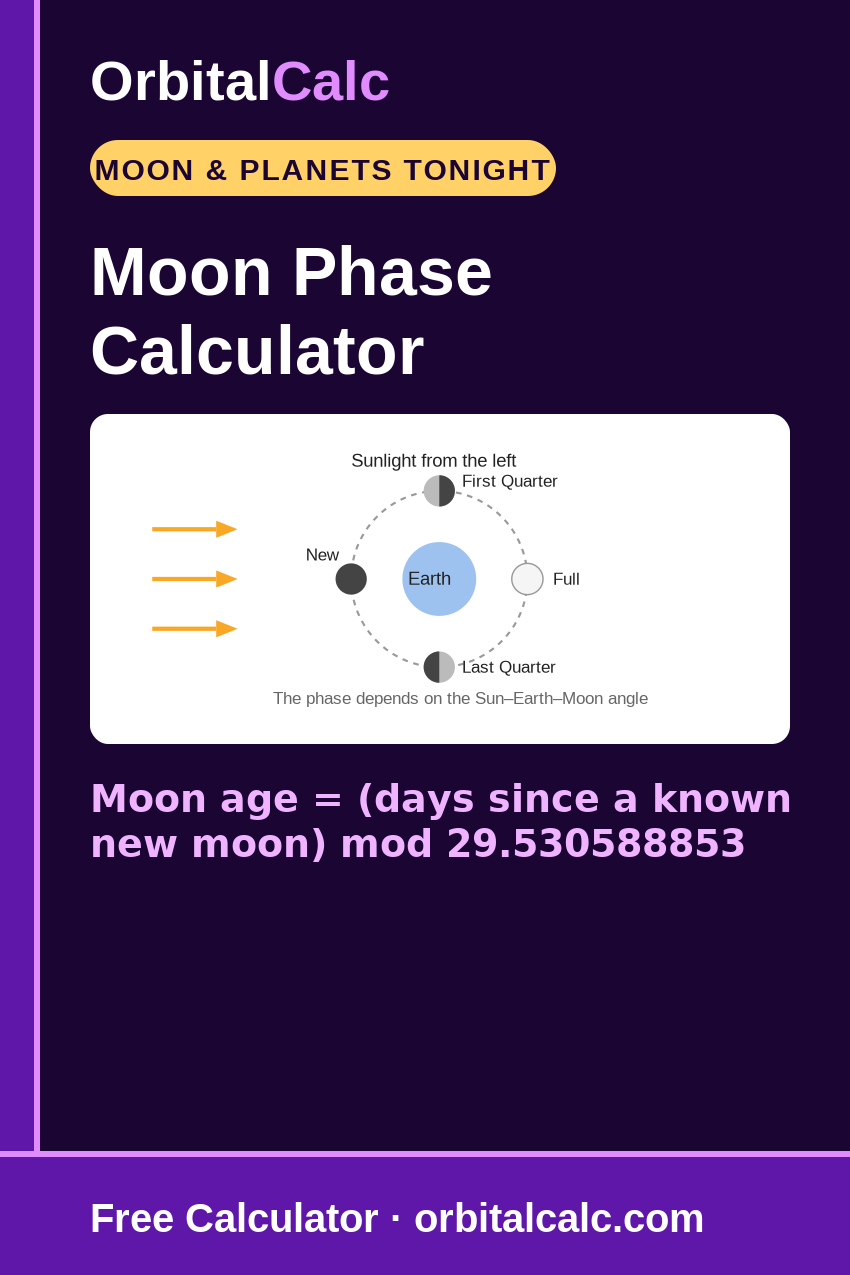
The Moon does not shine by itself. What we call moonlight is sunlight bouncing off the Moon's rocky surface, and the phase we see depends only on geometry: where the Moon sits in its orbit around Earth relative to the Sun. When the Moon is between Earth and the Sun, its lit half faces away from us and we see a new moon. Half a month later the Moon is on the opposite side of Earth, its whole lit face turned towards us, and we see a full moon. In between, we see a sliding fraction of the lit half — crescents, quarters and gibbous moons — as the angle changes night by night.
Because the Moon's orbit is so regular, the whole cycle repeats every 29.53 days, a period called the synodic month. That regularity is what makes a calculator like this possible: count the days since a known new moon, divide by 29.53, and the remainder tells you exactly where in the cycle any date falls. The same arithmetic lets you answer questions like "what phase was the Moon on the day I was born?" or "will there be a full moon on our wedding night?" in seconds.
Formula
Moon age = (days since a known new moon) mod 29.530588853, and illumination = (1 − cos(2π × age ÷ 29.530588853)) ÷ 2 × 100%.
This calculator counts from a well-established reference new moon: 6 January 2000 at 18:14 UTC. It takes the number of days between that moment and your chosen date (taken at midday UTC), divides by the synodic month of 29.530588853 days, and keeps the remainder — the Moon's age. The age then gives everything else. The illuminated fraction follows a cosine curve: zero at new moon, 50% at the quarters, 100% at full moon. The phase name comes from dividing the cycle into eight equal parts, each centred on its phase: ages near 0 are "New Moon", near 7.4 days "First Quarter", near 14.8 days "Full Moon", near 22.1 days "Last Quarter", with crescent and gibbous phases in between.
The next new moon is simply (29.530588853 − age) days away, and the next full moon is (14.765294427 − age) days away, wrapping around the cycle if that number is negative. Because real lunations vary slightly (the Moon's orbit is elliptical, so individual months run from about 29.18 to 29.93 days), this simple model can be out by up to about a day over long spans — plenty accurate for planning stargazing, photography or celebrations, but not a substitute for an almanac if you need the exact hour of a phase.
| Symbol | Meaning | Units |
|---|---|---|
| age | days since the most recent new moon | days |
| 29.530588853 | synodic month — average new-moon-to-new-moon period | days |
| illumination | percentage of the Moon's visible face that is lit | percent (%) |
| epoch | reference new moon, 6 Jan 2000 18:14 UTC | date/time (UTC) |
The eight phases
As the Moon orbits, its lit portion grows (waxes) from new to full, then shrinks (wanes) back to new. "Crescent" means less than half lit, "gibbous" means more than half lit, and the quarters are the half-lit moments — called quarters because the Moon is a quarter (or three-quarters) of the way through its cycle, even though we see half the face lit. A handy memory aid in the northern hemisphere: if the right side is lit, the Moon is waxing and growing; if the left side is lit, it is waning and shrinking. In the southern hemisphere the picture is flipped.
How to use
- Pick any date with the date picker — today, a birthday, a historical date, or a future event.
- Click "Calculate Moon Phase". You will see the phase name, the illumination percentage, the Moon's age in days, and the dates of the next new moon and next full moon.
- The date is taken at midday UTC, so results are the same for everyone worldwide on that calendar date.
- For the darkest skies (best for stargazing), look for illumination under about 20%; for the brightest moonlit nights, look for 90% or more.
Worked examples
Example 1 — a new moon. On 11 January 2024 the calculator gives a Moon age of 0.2 days and illumination of 0.0% — a New Moon. The next new moon falls on 9 February 2024 and the next full moon on 26 January 2024. This matches reality: the real new moon occurred on 11 January 2024, making that week ideal for deep-sky observing.
Example 2 — a full moon. On 25 January 2024 the age is 14.2 days and illumination is 99.6% — the Full Moon phase (the exact full moment follows within hours, on 25–26 January). The next new moon is 9 February 2024. A Moon this bright washes out faint stars but is perfect for moonlit landscapes and photography.
Example 3 — first quarter. On 16 February 2024 the age is 6.6 days with 42.0% illumination, in the First Quarter phase — the real first quarter fell that same day. Quarter moons are the best time to see craters along the terminator (the day–night line), where long shadows reveal the surface relief.
Example 4 — last quarter. On 3 March 2024 the age is 22.6 days and illumination is 44.9% — the Last Quarter phase, with the next new moon on 10 March 2024 and the next full moon on 25 March 2024. A last-quarter Moon rises around midnight and is a morning object.
Example 5 — an eclipse full moon. On 14 March 2025 the age is 14.7 days and illumination is 100.0% — a Full Moon. That night the full Moon passed through Earth's shadow in a total lunar eclipse (a "Blood Moon"), visible across the Americas. Eclipses can only happen at full moon (lunar) or new moon (solar), which is why phase calculators and eclipse calendars are cousins.
Example 6 — today, 26 November 2026. The calculator gives an age of 16.6 days and 96.3% illumination — just past full, still in the Full Moon phase band and beginning to wane. The next new moon is 9 December 2026 and the next full moon is 24 December 2026 — a Christmas Eve full moon.
Moon phases in real life
Stargazing and astronomy. Moonlight is the enemy of faint-object observing. Galaxies, nebulae and the Milky Way need a dark sky, so astronomers plan deep-sky sessions around new moon, when illumination is near zero for several nights. Conversely, the Moon itself is best observed at quarter phases, when the terminator's shadows make craters and mountains stand out in relief; at full moon the surface looks flat and washed out because the Sun is shining straight at it.
Photography. A full moon rising at sunset is the classic landscape shot, and it happens because full moon is opposite the Sun — it rises as the Sun sets. Crescent moons photograph beautifully in twilight, and a thin crescent a day or two after new moon, with "earthshine" faintly lighting the dark part, is a favourite target. Knowing the phase for a planned date lets you be in the right place at the right time.
Tides. The Moon's gravity drives the tides, and the phase tells you how strong they will be. At new and full moon, Sun and Moon pull together and produce the largest "spring" tides (the name has nothing to do with the season). At the quarters they pull at right angles, giving the smallest "neap" tides. Fishermen, surfers and coastal walkers all read the phase for exactly this reason.
Calendars and festivals. Many calendars are lunar or lunisolar: Islamic months begin at the new crescent, Easter is tied to the first full moon after the March equinox, and festivals such as Diwali (new moon) and Vesak (full moon) are fixed by phase. A phase calculator is a quick way to see why those dates move around the solar calendar from year to year.
Why the cycle is 29.53 days, not 27.3
The Moon orbits Earth in about 27.32 days relative to the distant stars (the sidereal month), yet the phase cycle takes 29.53 days. The difference is Earth's own motion: while the Moon goes around once, Earth has moved about 27 degrees along its orbit around the Sun, so the Moon must travel roughly two extra days to get back to the same Sun–Earth–Moon alignment. That 29.53-day synodic month is the number this calculator uses, and it is also why "a month" in most calendars hovers around 29–31 days.
Quick reference: the eight phases
| Phase | Age (days) | Illumination | Rises around |
|---|---|---|---|
| New Moon | 0 | 0% | sunrise |
| Waxing Crescent | ~3.7 | ~15% | morning |
| First Quarter | ~7.4 | 50% | midday |
| Waxing Gibbous | ~11.1 | ~85% | afternoon |
| Full Moon | ~14.8 | 100% | sunset |
| Waning Gibbous | ~18.4 | ~85% | evening |
| Last Quarter | ~22.1 | 50% | midnight |
| Waning Crescent | ~25.8 | ~15% | early morning |
The Moon's phases and the calendar
Almost every calendar humanity has used is a negotiation between the Moon's 29.53-day cycle and the Sun's 365.24-day year, and the numbers refuse to divide neatly: twelve lunations make 354.37 days, about eleven days short of a year. Purely lunar calendars, such as the Islamic calendar, accept the drift — its months slide through the seasons over a 33-year cycle. Lunisolar calendars, such as the Hebrew and Chinese calendars, insert an extra month every two or three years to pull the lunar year back into step with the seasons. The pattern of those insertions follows the Metonic cycle: 19 solar years contain almost exactly 235 lunations (19 × 365.24 = 6939.6 days; 235 × 29.530588853 = 6939.7 days), so the Moon's phases repeat on the same calendar dates every 19 years. If you note the phase on your birthday this year, the same phase will return on your birthday 19 years later.
The drift also explains the moveable feasts. Easter, in Western churches, is the first Sunday after the first full moon on or after 21 March — a rule that needs a phase calculator (historically, tables) to apply. Passover falls at the full moon of the Hebrew month of Nisan. Ramadan begins with the sighting of the new crescent. In each case the festival is pinned to the Moon, and its date in the solar calendar wanders — exactly the behaviour this calculator reproduces when you step a date forward year by year.
Earthshine and the crescent Moon
A few days either side of new moon, something subtle happens: the dark part of the Moon is faintly visible, glowing a dull coppery grey. That is earthshine — sunlight reflected off Earth onto the Moon and back. At new moon, Earth as seen from the Moon is full, and a full Earth is a brilliant lantern, roughly fifty times brighter than a full Moon appears to us. Leonardo da Vinci explained the phenomenon five centuries ago. Earthshine is strongest in the evening sky in spring, when the crescent is high after sunset, and it is one of the loveliest sights a small telescope or binoculars can show: the bright crescent cradling the ghostly full disc. Use this calculator to find dates with an age of 2–4 days (evening crescent) or 26–28 days (morning crescent) and look for it.
Supermoons and micromoons
The Moon's orbit is an ellipse, so its distance from Earth varies between about 356,500 km (perigee) and 406,700 km (apogee) — a 14% difference. A full moon near perigee is popularly called a supermoon: it appears up to about 14% wider and 30% brighter than a full moon at apogee, a micromoon. The phase calculation is unaffected — full is full — but the view differs, and supermoons also bring slightly higher spring tides. The effect is modest to the eye (you would need side-by-side photographs to be sure), but it is real, and it is why "supermoon" full moons draw crowds to coastlines and hilltops.
Common mistakes
- Thinking the phase is caused by Earth's shadow. It is not. Phases are pure geometry — we see different portions of the Moon's sunlit half. Earth's shadow only matters during a lunar eclipse, a few times a year.
- Expecting the exact hour. This calculator uses the average synodic month, so phase dates can differ from an almanac by up to about a day. For eclipse timings or religious observance, check an official source.
- Confusing "quarter" with a quarter-lit Moon. At first and last quarter the Moon is half lit; "quarter" refers to its position in the cycle, not the fraction lit.
- Forgetting the hemisphere flip. The lit side appears mirrored in the southern hemisphere — a waxing Moon there is lit on the left. The phase name and illumination are the same everywhere.
FAQ
How is the Moon phase calculated?
By counting days from a known new moon (here, 6 January 2000, 18:14 UTC) and taking the remainder after dividing by the synodic month, 29.530588853 days. That remainder is the Moon's age, from which the phase name and illumination follow.
What is the Moon's age?
The number of days since the most recent new moon. Age 0 is new moon, about 7.4 is first quarter, about 14.8 is full moon, and about 22.1 is last quarter.
How accurate is this calculator?
Typically within about a day for the phase dates, because real lunations vary between roughly 29.18 and 29.93 days while the model uses the average. It is ideal for planning, birthdays and general interest.
Why is a full moon sometimes called a supermoon?
When full moon coincides with perigee — the Moon's closest approach to Earth in its elliptical orbit — the Moon looks slightly larger and brighter than average. The phase calculation is unchanged; only the distance differs.
Can I find the phase on my birthday?
Yes — enter your birth date. Many people look up the Moon phase on the day they were born, or on anniversaries and wedding dates, just for fun.
What does illumination percentage mean?
It is the fraction of the Moon's visible disc that is sunlit, from 0% at new moon to 100% at full moon, following the cosine formula shown above.
Why do phases repeat every 29.53 days and not 27.32?
27.32 days is the Moon's orbital period relative to the stars. Because Earth moves around the Sun meanwhile, the Moon needs about 2.2 extra days to return to the same alignment with the Sun — hence 29.53 days between identical phases.
Is the phase the same everywhere on Earth?
Yes. Everyone on Earth sees essentially the same phase at the same moment (the view is mirrored between hemispheres, and the Moon rises at different local times, but the illuminated fraction is the same).
What is a blue moon?
The second full moon in a single calendar month — possible because a 29.53-day cycle occasionally fits twice into a 31-day month. It has nothing to do with colour.
When is the best time to observe the Moon?
For craters and mountains, around first or last quarter, when shadows along the terminator reveal relief. For a bright, fully lit disc and moonlit landscapes, at full moon. For dark skies and deep-sky objects, around new moon.
David is an amateur astronomer who writes about what you can actually see: Moon phases, full-moon dates, planet positions and choosing eyepieces. His tools are built for planning real nights under the sky.